Blood Sugar Matters Before a Diagnosis—and a Flat CGM Line Is Not the Goal
Oct 06, 2026Blood Sugar Matters Before a Diagnosis—and a Flat CGM Line Is Not the Goal
The Scho Fit Health Society Team.
Why we need to pay attention earlier without becoming afraid of normal physiology
“I don’t have diabetes, so I don’t need to think about my blood sugar.”
That belief can keep people from paying attention to their metabolic health for years.
As a cellular biologist and holistic nutritionist, I want you to understand something: blood sugar affects everyone. Your body does not suddenly begin managing glucose on the day a doctor gives you a diagnosis.
It has been doing that work your entire life.
Waiting until a type 2 diabetes diagnosis to take blood sugar seriously can mean missing years of opportunity to act earlier. But it is never a reason to believe you have missed your chance to improve your health.
We need earlier attention—and a better understanding of what healthy blood sugar regulation actually means.
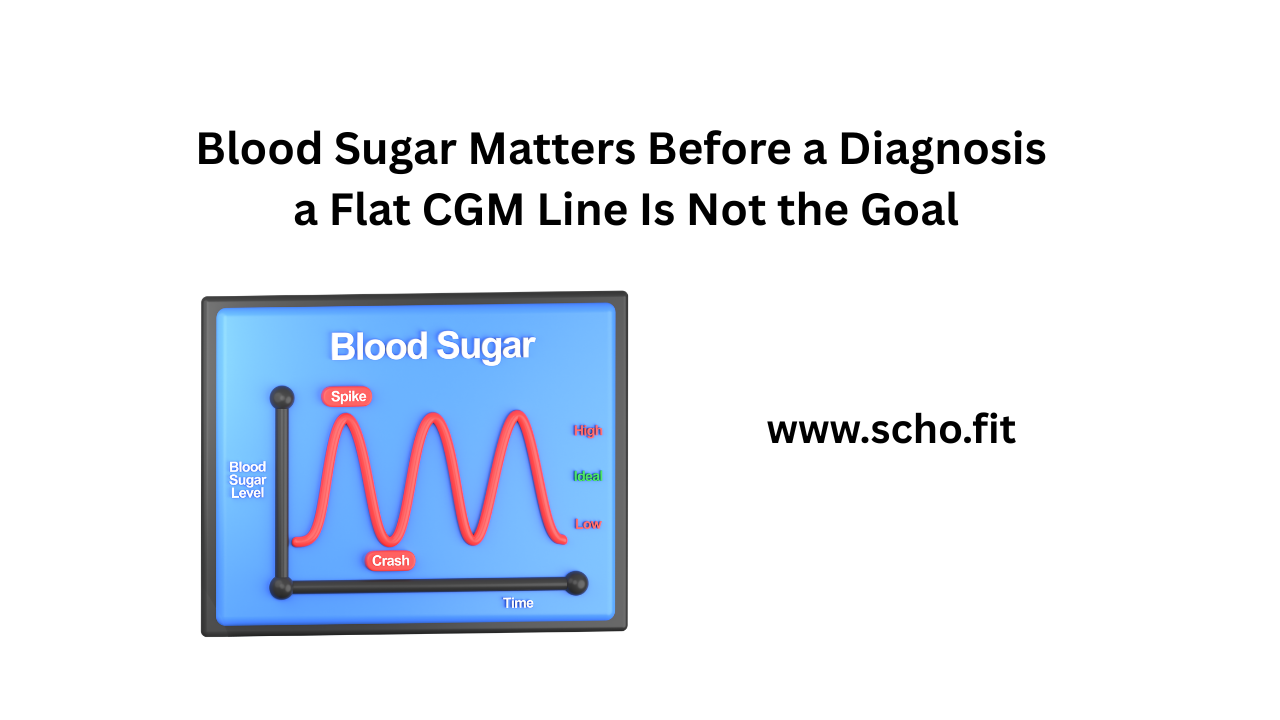
Because the opposite mistake is becoming increasingly visible: treating every rise on a continuous glucose monitor as a problem and making a perfectly flat line the goal.
Both approaches miss the bigger picture.
A diagnosis doesn’t tell you when the problem began.
Type 2 diabetes typically develops gradually.
Insulin helps regulate glucose, including helping muscle and fat cells take it in. When those cells become less responsive to insulin, your pancreas may compensate by producing more.
For a while, that extra effort can keep glucose within the normal range. Your blood sugar may look reassuring even though your body is working harder to maintain it.
If insulin production eventually becomes insufficient to meet the demand, glucose rises. This can lead to prediabetes and, in some people, type 2 diabetes. These early changes often have no obvious symptoms.
Think of a household paying its bills by steadily draining its savings. The bills are paid, but the financial situation deserves attention.
A normal glucose result is valuable. It cannot tell you everything about the effort required to achieve it.
That is also why insulin is not the enemy. It has essential work to do. The concern is a system becoming less responsive to its signals.
Your body doesn’t wait for a diagnostic label.
An A1C estimates your average blood glucose over approximately three months. The usual categories are:
-
Below 5.7%: normal range.
-
5.7%–6.4%: prediabetes range.
-
6.5% or higher: diabetes range.
When there are no clear symptoms, a diabetes diagnosis generally requires confirmation. These thresholds guide medical decisions, but risk does not suddenly appear when you cross a single decimal point.
Prediabetes already signals increased risk of type 2 diabetes, heart disease, and stroke. It can exist for years without clear symptoms.
“Not diabetes yet” deserves a conversation about prevention.
It should not require waiting until the next test gets worse.
Blood sugar affects everyone because everyone needs fuel.
Glucose is an important fuel for your body. Your brain, muscles, and other tissues use it. Insulin and other hormones help regulate its availability, and your liver helps maintain the supply between meals.
That system is active whether you are young or old, lean or carrying extra weight, exercising or sitting at your desk.
And a functioning system makes adjustments.
After a carbohydrate-containing meal, glucose generally rises as nutrients are absorbed. Your body responds by using and storing that energy. Between meals, your liver helps keep glucose available.
Movement in your glucose level is part of normal physiology.
In a multicenter study of 153 healthy people without diabetes, continuous glucose monitoring showed measurable variation throughout the day. Healthy glucose regulation did not produce an unchanging line.
The goal is an appropriate response to changing conditions—not eliminating every change.
Why chasing a flat CGM line can become harmful
A continuous glucose monitor, or CGM, estimates glucose using a sensor that measures the fluid between cells. It can be a valuable tool for diabetes management, including helping people recognize high and low glucose patterns and make informed treatment decisions.
The problem starts when the information is interpreted as:
“If this food raises your glucose at all, it is harming you.”
That is an unrealistic standard.
A normal rise after a meal is not automatically a dangerous spike. Its size, duration, frequency, and the person’s overall health matter.
When coaching treats every upward movement as a failure, people may start making choices to satisfy the graph instead of meeting their nutritional needs.
That approach can become harmful in several ways:
1. It can encourage unnecessary food restriction.
Someone may eliminate fruit, beans, lentils, or other nutritious foods simply because they produce a visible rise. A glucose trace alone does not measure a food’s fiber, vitamins, minerals, or contribution to an overall eating pattern.
2. It can encourage underfueling.
Skipping meals or eating too little to prevent any upward movement can leave someone without enough energy or nutrients. A flatter graph does not establish that the person is adequately nourished.
3. It can turn movement into compensation.
Walking after meals can be useful. Feeling compelled to exercise away every ordinary rise is a different pattern—especially if it leads to excessive activity or replaces appropriate nourishment.
4. It can encourage dangerous medication decisions.
Taking extra insulin or other glucose-lowering medication to force readings lower can cause hypoglycemia. Severely low glucose can cause confusion, seizures, loss of consciousness, and other serious consequences. Medication decisions need appropriate clinical guidance.
5. It can create false reassurance.
A relatively flat glucose trace does not establish healthy blood pressure, cholesterol, adequate nutrition, or normal insulin sensitivity. It is one source of information about one part of your physiology.
These are potential harms of the behaviors used to chase the number. Wearing a CGM does not itself stop your body from doing its job. Nor is there evidence that reducing unnecessary glucose excursions makes your pancreas “forget” how to work.
The accurate concern is that chasing zero variation can lead you to restrict nourishment or override normal physiology with unnecessary interventions.
Support your body’s ability to regulate glucose. Don’t make ordinary regulation something to fear.
A coach should explain the data, not make every meal a test.
If someone tells you that every increase is damage, ask:
“What evidence shows that this particular response is harmful for me?”
A CGM reading needs context. The sensor estimates glucose rather than directly measuring blood glucose, and readings can differ from a finger-stick measurement, particularly while levels are changing.
Research in people without diabetes is still developing. Researchers have highlighted the need for clear guidance on interpreting their CGM reports. That is a good reason to avoid sweeping claims that every healthy person should follow the same narrow target or eliminate every rise.
The FDA also advises users of its first cleared over-the-counter CGM not to make medical decisions based on its output without talking with a healthcare provider.
Information becomes useful when you understand what it means. More numbers do not automatically mean better decisions.
Normal variation and persistently high glucose are different concerns.
Recognizing normal physiology does not mean dismissing genuinely abnormal glucose.
Repeated or prolonged high blood glucose associated with diabetes can damage blood vessels and nerves, contributing to problems involving the eyes, kidneys, heart, and feet. Some changes, including certain eye changes, can begin during prediabetes.
A brief rise after eating and glucose that remains abnormally elevated are different patterns.
We need to take concerning patterns seriously while avoiding fear of normal responses.
And symptoms alone cannot settle the question. Fatigue, cravings, or an afternoon slump do not prove a glucose problem. Equally, feeling fine does not rule one out.
Appropriate testing and interpretation are more useful than either guessing or obsessing.
Your weight doesn’t tell the whole story.
“I’m thin.”
“I exercise.”
“I don’t eat much sugar.”
Those details matter, but none establishes that glucose regulation is healthy.
Type 2 diabetes involves problems with insulin action and insulin production. Genetics, age, medical history, and other factors influence risk. Appearance cannot reveal how effectively those systems are functioning.
Look beyond the scale—and beyond a single sensor reading.
What are your A1C and fasting glucose doing over time? What are your blood pressure and cholesterol? What is your family history? Are you receiving appropriate screening?
Those questions help build a more useful picture.
Earlier action can make a measurable difference.
In the Diabetes Prevention Program, adults at high risk for type 2 diabetes who received a structured lifestyle intervention reduced their risk of developing diabetes by 58% over approximately three years, compared with the placebo group. Among participants aged 60 and older, the reduction was 71%.
The intervention involved eating changes, increased physical activity, a modest weight loss goal, and ongoing support. These were relative risk reductions in that study, not guarantees for every individual.
The lesson is encouraging: increased risk does not make progression inevitable.
This evidence supports meaningful lifestyle change. It does not establish zero glucose variation as a health goal.
What this means at Scho Fit
At Scho Fit, I want you to understand your health before a diagnosis forces the conversation.
We look at food patterns, movement, muscle, sleep, and daily routines alongside the information your healthcare team provides. We work on practical habits you can sustain and help you understand why they matter.
If you use a CGM, its information should support that process. It should not become a food judge that labels every rise a failure.
A nutritious meal does not have to produce a perfectly flat line to be worthwhile.
If you already have diabetes, this work still matters. Managing glucose can help prevent future complications. Continue prescribed treatment, and coordinate medication changes with your healthcare team.
You have not missed your chance to benefit.
But you also do not need to wait for a diagnosis to begin.
Pay attention early. Nourish yourself adequately. Learn which patterns deserve action—and which changes are your body doing exactly what it is designed to do.
References
-
National Institute of Diabetes and Digestive and Kidney Diseases. Insulin Resistance & Prediabetes.
https://www.niddk.nih.gov/health-information/diabetes/overview/what-is-diabetes/prediabetes-insulin-resistance -
Centers for Disease Control and Prevention. Prediabetes—Your Chance to Prevent Type 2 Diabetes.
https://www.cdc.gov/diabetes/prevention-type-2/prediabetes-prevent-type-2.html -
National Institute of Diabetes and Digestive and Kidney Diseases. The A1C Test & Diabetes.
https://www.niddk.nih.gov/health-information/diagnostic-tests/a1c-test -
Shah, V. N., et al. (2019). Continuous Glucose Monitoring Profiles in Healthy Nondiabetic Participants: A Multicenter Prospective Study. The Journal of Clinical Endocrinology & Metabolism, 104(10), 4356–4364. https://doi.org/10.1210/jc.2018-02763
Full text: https://pmc.ncbi.nlm.nih.gov/articles/PMC7296129/ -
National Institute of Diabetes and Digestive and Kidney Diseases. Continuous Glucose Monitoring.
https://www.niddk.nih.gov/health-information/diabetes/overview/managing-diabetes/continuous-glucose-monitoring -
Boston University Chobanian & Avedisian School of Medicine. (2025). Guidelines Needed for Interpreting Continuous Glucose Monitoring Reports in Those Without Diabetes.
https://www.bumc.bu.edu/camed/news-events/articles/2025/guidelines-needed-for-interpreting-continuous-glucose-monitoring-reports-in-those-without-diabetes/ -
U.S. Food and Drug Administration. (2024). FDA Clears First Over-the-Counter Continuous Glucose Monitor.
https://www.fda.gov/news-events/press-announcements/fda-clears-first-over-counter-continuous-glucose-monitor -
National Institute of Diabetes and Digestive and Kidney Diseases. Low Blood Glucose (Hypoglycemia).
https://www.niddk.nih.gov/health-information/diabetes/overview/preventing-problems/low-blood-glucose-hypoglycemia -
National Institute of Diabetes and Digestive and Kidney Diseases. What Is Diabetes?
https://www.niddk.nih.gov/health-information/diabetes/overview/what-is-diabetes -
National Institute of Diabetes and Digestive and Kidney Diseases. Diabetic Eye Disease.
https://www.niddk.nih.gov/health-information/diabetes/overview/preventing-problems/diabetic-eye-disease -
National Institute of Diabetes and Digestive and Kidney Diseases. Diabetes Prevention Program (DPP).
https://www.niddk.nih.gov/about-niddk/research-areas/diabetes/diabetes-prevention-program-dpp
Don't miss a beat!
New moves, motivation, and classes delivered to your inbox.
We hate SPAM. We will never sell your information, for any reason.
